
Baltimore County voters made history in the Nov. 3 general election, ushering in an unprecedented wave of change in the county’s political leadership. With one of its highest general election turnouts in years, residents elected the county’s first Black county executive, first Black sheriff, and first Black woman, first Latino to hold elected office, and youngest member to serve on the County Council. (See photos of the Julian Jones’ watch party.)
The historic victories come as the county confronts a range of pressing concerns, including rising energy costs, juvenile crime, and controversial proposals to build data centers and other development projects. Together, the election results signal a new chapter in county government with leadership that reflects the county’s growing diversity within its 850,000 residents.
The newly elected officials will be sworn in during the Dec. 7 inaugural ceremony at the SECU Arena at Towson University.
‘We Did It!’
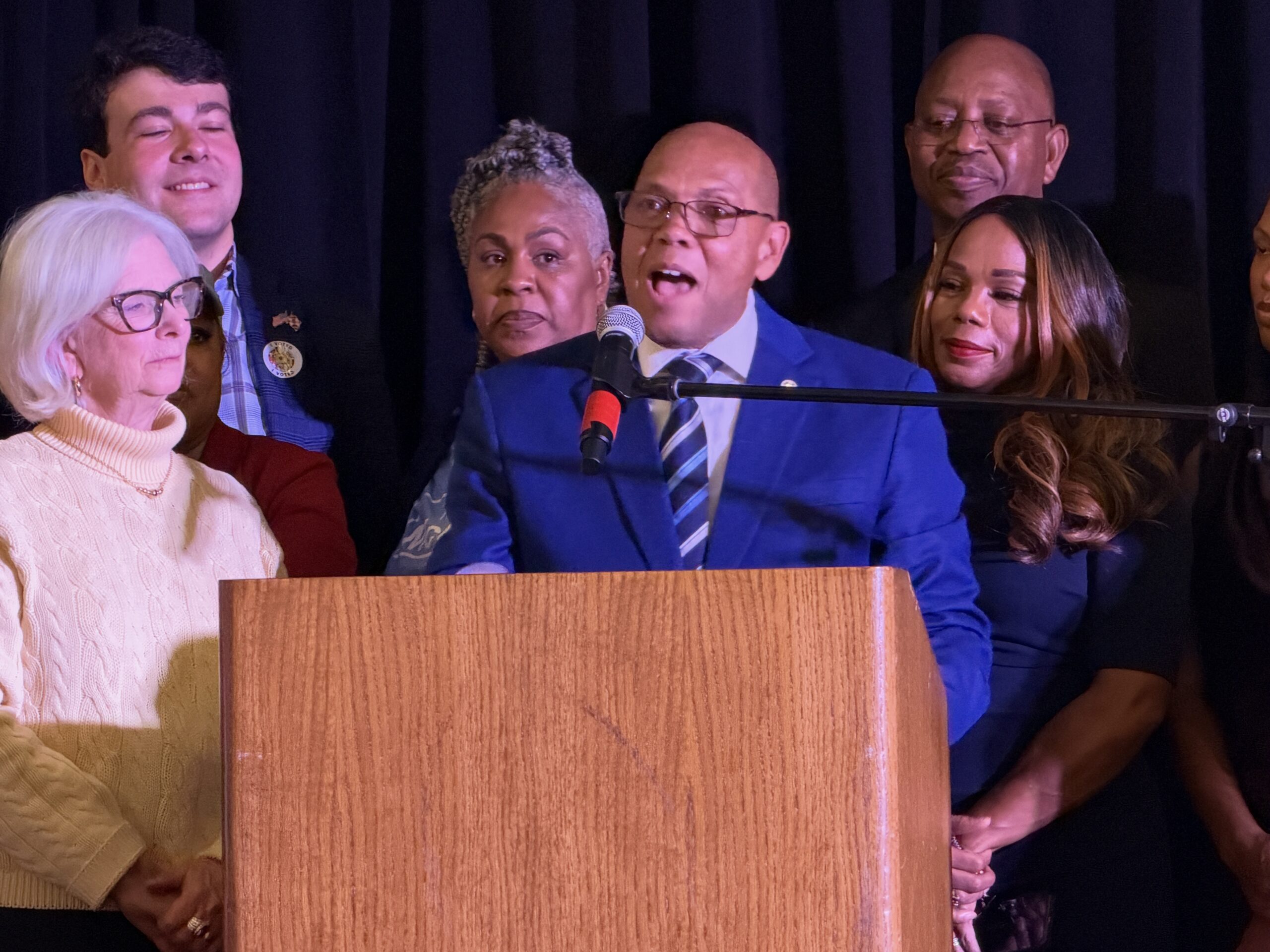
A yearslong campaign for the county’s top spot culminated in victory for three-term councilman Julian Jones. With a commanding lead as votes were being tallied, Jones appeared before supporters who gathered at the Sheraton North in Towson for his election-night watch party as the Baltimore County executive-elect and declared, “We did it! We did it! We did it!” Th thanked family, volunteers and county residents for “your trust, faith in me, and giving me the opportunity to make history tonight.”
In his remarks, Jones also told a cheering crowd, “When you call you’ll get an answer. When you bring us a problem, we will work to achieve results. Even when the work gets difficult, you can trust that I will persist that I will deliver a return on the hope that you’ve invested in me.”
A longtime resident of Woodstock, Jones has represented District 4’s Randallstown-Owings Mills-Reisterstown area since 2014. He now prepares to lead a county where nearly one-third of the residents are Black or minorities, and is grappling with issues related to development, a lack of affordable housing and education matters.
Jones succeeds Kathy Klausmeier, a former state senator who became the county’s first female executive after being selected by the County Council to complete the term of Johnny Olszewski, who won a congressional seat.
U.S. Representatives Olszewski and Kweisi Mfume were among the elected officials who introduced Jones at his election-night celebration.
County Leadership
The election marks a significant transition in the county’s law enforcement leadership, with new faces preparing to take the helm of two key offices after years of established leadership.
Sarah David, a deputy state prosecutor in the Office of the Maryland State Prosecutor, is poised to become the county’s next state’s attorney. She succeeds five-term incumbent Scott Shellenberger, who has held the office since 2006. Before Shellenberger, Republican Sandra Day O’Connor served as the first woman in the position.
“We’re going to be focusing on making Baltimore County safer,” David said, and sexual violence and juvenile justice are among the priorities she intends to address. Also, because communication is essential, David said, “We’re going to have advisory committees not just for the transition process, but throughout my tenure as state’s attorney to make sure that we’re continuing to engage with the community.”
A mother of two, David pointed out that she’s among the first countywide female candidates with young children to serve in an elected role.
Clyde Boatwright, a resident of Middle River, will become the county’s next sheriff and first Black in that role. The Maryland Fraternal Order of Police president and sergeant with the Baltimore City Public Schools Police Department, Boatwright succeeds R. Jay Fisher, who has served as sheriff since 2002.
Elsewhere in county government, Julie Ensor won another term as clerk of the Circuit Court. Formerly an Orphans’ Court judge, Ensor will serve her fourth term.
Attorney Alexis Burrell-Rohde, who has served as register of wills since 2021, also won reelection to a second term.
Baltimore County Council Seats
The redistricting effort, which expanded the Baltimore County Council from seven to nine members and redrew district boundaries, helped attract a more diverse field of candidates. Council members will make history and are expected to bring new perspectives and greater diversity to the expanded nine-member body.
On the solidly Democratic west side sector of the county, several council races appeared largely settled. In the southwest, Paul Dongarra, a project manager and environmental advocate, will represent District 1, which encompasses Catonsville, Arbutus and Halethorpe. Dongarra is a resident of Catonsville.
Ruben Amaya, third vice president of the Maryland Democratic Party and president of the Young Democrats of Maryland, will become the first Latino elected to the council. The Reisterstown resident emerged victorious from a highly competitive primary and will represent District 2, which includes Windsor Mill, Reisterstown and parts of Randallstown.
Issues he plans to tackle are housing affordability, revitalizing the westside’s Liberty Road and Security Square Mall, revitalizing vacant properties and propping up the county’s development.
Makeda Scott, an Owings Mills resident and former chair of the Baltimore County Board of Education, won a four-way primary before defeating her general election opponent. She is poised to become the council’s first Black female member. Scott will represent District 3, which includes Owings Mills and most of Randallstown.
Karson Kamenetz, a law student and son of former County Executive Kevin Kamenetz, won election to represent District 4, which includes Pikesville, Woodlawn and Brooklandville. At age 25, the Pikesville resident will be the youngest person to serve on the council. Amaya, also 25, and Kamenetz will become the council’s first Gen Z members.
Other Council Races
Beyond the historic victories, the election featured closely contested races for County Council on the east side. In the five districts, the number of Republican and independent voters combined outnumber Democratic voters, making the results more unpredictable.
Two were decided in favor of incumbents: Democrat Council Chair Mike Ertel in District 6 and Republican David Marks in District 7.
The other three contests in Districts 5, 8 and 9 remain uncalled as of Nov. 5 as election officials continued counting mail-in and provisional ballots. The Democratic candidates – all women – trailed their Republican opponents as of election night but are gaining ground.
On election night, Shawn McIntosh in District 5, which includes Timonium and Lutherville; Sharonda Dillard-Huffman in District 8, which includes Essex and Middle River, and Arkia Wade in District 9, which includes Dundalk and Sparrows Point, were among those facing difficult contests.
Board of Education
One contest for the school board remained too close to call as officials continued counting mail-in and provisional ballots.
Former educator Candice Logan-Washington and former board member Lisa Mack were locked in a close race to represent southwest District 1. Before canvassing of mail-in ballots began Nov. 4, Logan-Washington held a narrow lead. That margin widened after two days of canvassing, although election officials continued to describe the contest as too close to call.
Elsewhere on the west side, Jane Lichter in District 2 and Brenda Savoy in District 4 ran unopposed.
On the east side, voters chose newcomers over two incumbent board members. Kelli McClelland defeated Maggie Domanowski in District 3, while Stacy McNish unseated Rod McMillion in District 7. Christina Pumphrey retained her District 6 seat, and Julie Henn continues to represent District 5 without a challenger.
Three days of canvassing sessions were scheduled to account for the remaining mail-in and provisional ballots. State officials have until Nov. 13 to certify the election results.
At the statewide level, Maryland voters returned several Democratic incumbents to office, maintaining continuity in the state’s top leadership positions.
State House and Other Statewide Races
Gov. Wes Moore and Lt. Gov. Aruna Miller secured a second four-year term, defeating Republican attorney Dan Cox in a rematch from the 2022 gubernatorial election. Moore captured 59.1% of the vote. Currently the only black governor in the country, Moore will be joined come January 2027 by four others elected in the Florida, Georgia, Wisconsin and Nevada midterms.
Attorney General Anthony Brown also won a second term, receiving 65.2% of the vote, while Comptroller Brooke Lierman secured another term with 65.8%.
State Senators Ben Brooks of District 10, Shelly Hettleman of District 11 and Charles Sydnor III of District 44 won reelection to the Maryland General Assembly.
In the contest for House of Delegates, former school board vice chair Robin Harvey, who won the open District 10 seat vacated by Speaker Emerita Adrienne Jones, will join incumbent Delegates N. Scott Phillips and Jennifer White-Holland.
In the Pikesville and Owings Mills area, Delegates Cheryl Pasteur of District 11A and Jon Cardin and Dana Stein of District 11B also won their races.
District 44A will continue to be represented by Delegate Eric Ebersole, while District 44B will be represented by Delegates Aletheia McCaskill and Sheila Ruth.
U.S. Congressional Contests
In the congressional races, Baltimore County voters also returned their representatives to Washington. Congressman Olszewski, who represents District 2, which covers most of Baltimore County, won reelection with 68.5% of the vote. Congressman Kweisi Mfume, whose district includes Baltimore City and portions of the county, also won handily, capturing 67.1%.
Their victories were part of the broader national political shift, where Democrats won enough seats to gain a majority in the U.S. House and Senate.
Ballot Questions
- Question A requires that to preserve farmland, the County Council must have at least six of nine votes to make changes to the URDL.
- Question B establishes a Department of Agriculture.
- Question C establishes a board to appoint the inspector general and establishes a residency requirement. Currently the county executive appoints the individual.
- Question D increases the number of Charter Review Commission members appointed by the County Council from seven to nine for purposes of matching the expansion of the council.
- Question E changes the Board of Recreation and Parks’ membership and clarifies that it is an advisory body to the Department of Recreation and Parks.
- Questions F through N involved borrowing for nine categories of projects related to funding for: refuse disposal, community college, public works, Parks, preservation and greenways, school construction, Agricultural and Rural Land Preservation, capital improvement projects, waterway improvement program, and public operational buildings.